
This article is part of the ongoing Meditation for All challenge. Subscribers to the free newsletter receive weekly guidance and a daily practice.
Is Meditation a Placebo?
Meditation can often look like doing nothing, but that couldn’t be further from the truth. Meditation is very active. It is the act of mastering being both highly alert and highly relaxed. Being in these two states simultaneously trains our mind and body to remain in that state as we go about interacting with the world around us.
Meditation is the literal training of our mind to be focused, patient, highly aware and highly peaceful. It trains our mind to tap into the peace and joy within. While it is not a placebo, placebos are actually a very powerful tool we can all use in our daily lives. Placebos are why a sugar pill can cure someone of their cancer. Simply believing something is helpful does make it so.
Is meditation a placebo? It can be easy to question if meditation really works because whether we’re learning a language or a musical instrument, progress is slow. We can wonder if we’re making any progress at all. A long time can pass, and we can think to ourselves, “Am I any better?”
Then just a few days later, we realize, “Wow, I just did something I never thought I’d be able to do.” Meditation is a lot like that. We spend most of our lives constantly thinking, constantly distracted by entertainment, social media, tasks, food, friends, and everything else that keeps our mind racing and stimulated. We’ve lost our ability to be at peace in stillness and quiet.
When we first start meditating, we’re not just learning a new thing.
We’re also unlearning, sometimes decades of habitual thinking and behavior.
Meditation can be very discomforting at first. It’s a very unusual thing to practice being present, to practice being at peace, and finding the inner peace and inner joy, which we’ve been searching for outside of us our entire lives.
The the racing, thinking mind, often fights us as we try to make it obsolete. It’ll say things like, “This isn’t doing anything. This is pointless. I should quit. Why am I putting myself through this? I’m gonna go check my phone.”
The question of whether meditation is a placebo comes from that overthinking, racing mind. But in reality, what you are doing every single day that you meditate is training your mind to be more present, more focused, more aware, and more peaceful. To stop avoiding a difficult emotions, thoughts, and a difficult past. They’re always there under the surface. We can easily avoid them in modern society a million distractions. The mind will blame meditation for causing the pain and discomfort, but it is not the meditation’s fault. It doesn’t cause the unease that we keep buried. Meditation only shows us what’s there, not for punishment, but so we can become conscious of it, so we can work through it, and we can release it.
Like training at the gym, reaching our ideal physical fitness level can take years, and it can take a long time before we even see results. Training the mind can also take a little while before we can look back and say, “Wow, my whole life has changed. I can’t believe how much happier I am.”
When we realize the deep peace and joy residing within, everything becomes more joyful, more meaningful, and more fun because there’s no attachment to those temporary experiences. There’s no dependence on the experience. There’s just enjoyment and appreciation for all of the varieties of experience in life.
For so much of our lives, we suffer out of mere impatience. We get stressed waiting in line, stuck in traffic, we want everything immediately, and we want to get rich quick. Many young people today don’t have the patience to sit through a movie without having their phones out too.
Waiting for the microwave to ring, waiting for a call, waiting for a friend, and even just brushing our teeth — we’re always waiting. It can feel like a chore and make life miserable. Or we can discover the magic of peace.
When we are able to sit and do nothing for an extended period of time as we do in meditation, then an hour at the DMV, a few minutes in traffic, and waiting to check in to your flight the day before Christmas become pleasant and joyful as well. When we master simply sitting and enjoying the peace and joy within us, we’ll find out just how much of our suffering was caused by impatience alone.
While meditation has nothing to do with placebos, placebos, in and of themselves, can actually be very useful. People have cured themselves of every kind of disease through placebos. It is a strange yet miraculous phenomenon that when a person believes they’re healing, their body starts to heal. In some scientific studies, patients can even be told they’re being given the placebo, and it still works! If they later stop taking the placebo, their diseases come back.
This is just proof that the mind is so powerful, that your belief can completely change your reality.
Whether it’s belief in a sugar pill as a miracle treatment, or whether it’s putting all of your trust in the universe/God/yourself, you are more likely to heal the more you believe. If you believe, and trust, in the universe or God, and that everything happens for a reason, that everything is perfect and happening just the way it supposed to, that everything will work out, and that the human body is a miraculous organism with unlimited healing capabilities, it will contribute positively to the healing process.
You will have less stress, more happiness, and more peace. There’s nothing wrong with placebos; they are wonderful tools at our disposal and can drastically improve and save lives. However, meditation requires no belief, no faith, and you can still enjoy all the amazing benefits.
Is Meditation a Religious Activity?
Along with meditation’s sudden rise in the West came a lack of information, a great deal of misinformation, and even some disinformation.
Meditation is a completely non-religious activity that requires no belief in anything. It’s not just for Hindus, Buddhists, and atheists. Meditation is like dinner. Anyone can eat it and it is nourishing for all, regardless of what you think of it.
The two most common types of meditation are mantra and breath meditation. Mantra involves repeating a sound or word silently to yourself. It’s no different than silently humming. The sounds are often either meaningless, or they can have some meaning to you, whether it’s a foreign word you connect with, a phrase you want to remind yourself of, or a word you like.
Breath meditation is focusing on breath. This is a present moment meditation that does not create an artificial focal point. It is observing what is, as it is. We’ll go into other types of meditation later.
No God ever said that it’s a sin to spend a few minutes a day focusing on our breath. Or repeating a sound. Quite the contrary. God/the Universe prefers us to be present, observe, and appreciate all of God’s/the Universe’s creation. We breathe because of creation. It is no sin to marvel and wonder at the miracle of life itself.
Meditation is no more religious than watching a sunset or looking deeply at a flower. It is merely practicing the act of observation and concentration. If you can watch a football game, you can watch your breath. If you’re allowed to watch a puppy playing, you can watch your breath.
By closing our eyes and sitting still, we’re able to turn our gaze inward and thus increase our understanding of the nature of our mind and body. We thereby remove all ignorances, cease habitual thinking and negativity, and increase our wisdom, peace, and joy.
Does Too Much Meditation Cause Side Effects?
With the rise in the popularity of meditation, many people are beginning to wonder if there is a downside to meditation. Some people have heard stories or read articles about people having side effects like panic attacks. Other people have heard stories about people withdrawing from their lives. Rumors of people becoming addicted to meditation have even been reported.
So, I would like to once and for all address each one of these as someone who has worked with thousands of meditators and seen all kinds of different reactions people have to meditation.
Meditation typically has no negative side effects. In very rare cases, people have reported crying, shaking, or experiencing tics during their initial attempts at meditation. This is not due to the meditation itself but rather because it’s the first time the person has ever sat down and just observed their own mind and body.
This is a very strange experience; like looking at a mirror that reflects your soul. All of a sudden, many unconscious thoughts and feelings come to the surface for the first time. This process is an important part of healing and growth.
Is Meditation Just Sitting Still?
Meditation is much more than just sitting down with your eyes closed. During meditation, we actively bring our awareness to the present moment, while noticing our mind’s tendency to dwell on the past or worry about the future. Repeatedly, we redirect our attention back to the present moment.
Some people do this by focusing on their breath, a mantra, their body, or on whatever activity they’re doing. Meditation is not just for sitting. We can practice entering a meditative state throughout the day by focusing completely on the task.
When done correctly, meditation trains the mind to focus on the present moment, heighten its awareness, and become more aware of subtleties. By doing so, we can expand our consciousness, increase patience, and have better focus and concentration. We do this by starting with something easy like a mantra. Then as the mind becomes sharper and subtler, we start to focus on the breath. As the mind becomes more quiet and aware, we may wish to move on to the body, where we notice all of the most subtle sensations, further finely tuning our mind.
When we are more aware, able to concentrate better, allow time for our minds to process information, clear our heads of any distraction, understand the nature of our own mind, see and understand the impermanent nature of reality, and regularly practice recognizing how all things are connected, we become wiser, more thoughtful, more loving, more compassionate, more joyous, more grateful, and more peaceful.
Does Mindfulness Mean Suppressing My Thoughts?
Is mindfulness about controlling our thoughts or suppressing them? Is it even possible to achieve that? Is it worth trying?
We all know from experience that we can’t control our thoughts. If someone says, “Don’t think of a purple elephant,” we think of big giant purple elephants.
While we know we can’t suppress your thoughts, we also know that it doesn’t really help. We’re just stuffing them down. But they’re still there, bubbling under the surface, waiting to explode, whether it’s in the form of anger and temper, depression and anxiety, panic attacks, or even heart disease, cancer, or chronic pain.
All of that unprocessed trauma and negativity that we have buried within us doesn’t just disappear. It’s being buried it deeper and deeper, making it harder and harder to heal, evolve, and let go.
Attempting to control or suppress our thoughts leads to bad outcomes. The best thing we can do is learn to focus our mind, focus our attention.
Think of it like this: you’re walking down the street, there is someone screaming hateful things on one side of the street, there is a violent man with a knife on the other side of the street, and in the middle of the street is a beautiful flower.
To control your thoughts would be to try to look away from the hateful person. However, you’re still hearing everything they’re screaming. You’re fixated on it, even though you’re desperately trying to look away because that is what is grabbing your attention.
You could try to stuff the guy wielding a knife into your pocket and try to ignore it in that way, but it’s just going to cut up your leg and do all sorts of damage. The only option is to learn how to focus your mind with intention, and we can do that by using the flower. We can choose what we focus on.
We can’t ignore what we’re focusing on. We can’t suppress what we’re focusing on. But we can learn to choose what we focus on. That is the practice of meditation — learning to focus our mind wherever we choose, whether it’s on our breath, our body, or a mantra.
Meditation is mental focus training, so that when scary thoughts enter our mind, we don’t ignore them. We don’t stuff them down. We don’t try to shut them up. We simply bring our attention to this moment. A mantra or moment of presence interrupts thoughts in their tracks and creates a new train of thought starting from peace. By focusing on a mantra, the breath, body, or surroundings, we become fully present and thoughts become irrelevent background chatter. The thoughts, past, and present no longer take up our full field of awareness.
We can think of it like the ocean. If we just focus on the waves, and maybe they’re turbulent, crashing, stormy waves, then that’s all we know. But if we expand our perspective and realize that 99.9% of the ocean is beneath the waves, and that the deep ocean is peaceful, calm, still, and quiet, then those four meter waves become insignificant. The key is expanding our perspective and learning to control our focus, not our thoughts.
If I’m Not Having a Magical Experience, Does That Mean I Am Not Meditating Correctly?
Nuh-uh. Especially when just starting to meditate, disturbing, repressed thoughts and emotions may bubble up to the surface. It may be uncomfortable, but thank goodness it’s no longer bubbling beneath the surface waiting to explode in a rage or manifest as disease.
Sometimes, meditation may be like beautiful fireworks and light shows. Other times it will be grueling. It does not matter. Meditation isn’t about the meditation itself. It’s about how it improves the rest of our day and our life.
For people who have spent decades not meditating, always busy, and always doing stuff, suddenly leaving the physical world and turning inward in meditation can be very jarring. They’re not used to it. We’ve all grown impatient and entertainment-dependent since smartphones. But that’s all ok because it gets easier over time. The experience of meditation may not always be magical, but the results always are.
Is Meditation Doing Nothing?
No way! Meditation is a very active practice. It may look like nothing, but inside, deep concentration and sustained focus are taking place. Patience and discipline are being exercised. It is heightening our alertness and calm peacefulness. It rewires the brain, boosts our happiness chemicals, lowers stress, and trains the mind to be more present and intentional.
Meditation is not at all sitting down and doing nothing. It is actively focusing on a mantra, our breath, or our body. We focal with as much effort as if we were studying for med school. We practice focusing and blocking out all internal and external distractions. By practicing raising awareness of our mantra, thoughts, breath, or body, we are raising our awareness in everything.
The more we can sit still, with no distractions, no entertainment, no phones, and just be, the more patience, focus, and concentration we have. Finding the peace within drastically improves every aspect of life.
Is Meditation Just Wishful Thinking?
Yeah right! Hundreds of peer-reviewed scientific studies have shown that meditation literally changes the size and shape of the brain. Parts of the brain associated with fear become smaller. The regions associated with regulating emotions and learning become larger. Even overall gray matter increases!?
Also, a little meditation has shown measurable increases in happiness, gratitude, a sense of oneness and connectedness, peace and joy. Not to mention a decrease in stress, blood pressure, chronic pain, anxiety and depression.
If a pill did all that for a thousand dollars a month, we’d call it a miracle cure and it would sell out in 5 minutes. Luckily, meditation is free, infinite, everyone can do it, and it’s fun if we go into it with a positive, curious, and playful mindset.
In the next article, we’ll look at what actually changes when you meditate every day, how it influences your relationships, and what meditation has to do with success.
The Meditation for All Challenge takes place in my newsletter, where I share:
• Weekly practices that accompany the reading
• Common difficulties and how to work with them
• Step-by-step instructions for meditation mastery
If you are reading this on the website, make sure you’re subscribed so you don’t miss the next step.
The Challenge Has Now Become a Book
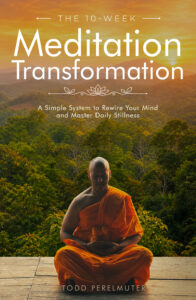
The full 10-week meditation journey, along with expanded teachings and answers to additional reader questions, is now available as
The 10-Week Meditation Challenge: A Simple System to Rewire Your Mind and Master Daily Stillness.
These 5 Minutes Could Shift Your Whole Week
Path to Peace Newsletter