

This article is part of the ongoing Meditation for All challenge. Subscribers to the free newsletter receive weekly guidance and a daily practice.
Meditation is our natural state of being. It is a state of being totally present and alert. We are mindful of ourselves and our surroundings. It is a state of complete inner peace and joy.
Ever since humans began farming and settling down, we lost this way of being. Instead of being present, we had to obsess about past crop cycles and plan for future harvests. Later, as industries began to crop up, such as news and entertainment, our minds became even more dislocated from the here and now.
This gave rise to the practice of meditation — a simple, easy practice where we spend a few minutes being present and alert by turning our attention inward and focusing on our breath, our body, or a mantra.
Meditation is the act of turning our attention away from the material world and turning it inward. We tune into our breath and the present moment, becoming fully conscious of our environment and our sensations, without looking through acloud of thoughts, opinions, and judgments.
In meditation, we enter the state of being, as opposed to the state of constant doing we are normally in. Being is our natural state of being.
We humans, are in our heads all the time, always engaged in mental activity. It’s so common that we don’t even realize doing it most of the time. But this is not natural or peaceful.
We would never look at a horse and say, “That horse is too in its head.” The idea doesn’t make any sense because horses are just experiencing life and reacting in a very conscious, mindful way.
Before the agricultural revolution, when humans first learned to farm, we were foragers like every other primate on Earth. Once we learned to farm, we settled down, built up large cities and states, labored long hours in the fields, meticulously planned the crop cycles, built up ever larger city infrastructure, formed armies to protect them, and over time, they developed into the civilization we have today.
Over time, trillion-dollar attention-stealing industries cropped up. To name just a few, there was the film and television industry, radio, newspapers, magazines, podcasts, social media, video games, drugs and alcohol, gambling, sports, and jobs. The days spent looking for food, fixing up the hut, and being with our families are long gone. So too is our ability to be fully present and alert.
All of these attention thieves have filled our lives to the point where anytime we’re sitting still, it feels alien to us. We’re not comfortable with it. We find it boring and too challenging. That’s what many people say about meditation when they first try it.
It’s a shame because not only is presence our natural state of being, it is also our most peaceful way of being. I don’t think there’s a wild horse in nature that has been bored for one second. They just live and enjoy their lives, relishing the peace of it.
We struggle with world peace because we can’t handle peace for more than a few minutes without feeling intense boredom and the need to create some kind of chaos in our lives, often enjoying the chaos of others through the media. Meditation trains our brains to settle into a healing, peaceful, present state where everything is joyful.
When we observe a baby or an animal, we’ll see that they experience no suffering unless they’re in the midst of experiencing pain or danger at that very moment. However, once the threat is gone, there’s no dwelling on it with thoughts like, “That was really bad. Why even go on?”
Only humans live in the past and the future as our normal mode of being. We operate these bodies and can get through the day, but we’re not really present. We live in our head, asleep at the wheel, for most of our lives.
Meditation, as a practice of sitting down, closing your eyes, and centering your attention on the present moment — be it through your breath, body, or surroundings — is akin to training the mind for increased peace, happiness, and bliss in our daily lives. It serves to subdue the unconscious generation of suffering by the thinking mind, offering a pathway out of the endless cycle of thought that we all experience.
So when we meditate, we are actually being ourselves.
It’s not how society has conditioned us to be, but it’s how humans lived for most of human history before we started living in time — past and future. Like every other animal on earth, and even how babies experience life, so too were adult humans once majestic and perfect beings. We were completely one with nature, fully present and alert, fully conscientious and aware.
This mental state of relaxed alertness is the state of mind that meditation can put us in. It can also help us stay in that way of being long after the meditation is over.
By learning to meditate, we learn to get back our birthright of peace. We can shut out all the distractions and excitement of modern life, and for a short period of time, we can just be.
We can still our body, quiet our mind, and tap into our innate love, peace, and presence that we share with the whole of nature.
What Does a Meditative State Actually Feel Like?
Ever wondered if you’re actually meditating while you’re meditating?
Ever wondered what a meditative state is like?
These are fascinating questions because, at times during meditation, all we seem to do is think. So, is there a distinction between the meditative mind and the thinking mind? In short, absolutely.
Here’s the difference:
When we are thinking, we experience what we often refer to as monkey mind. In this state, our mind jumps from thought to thought, chaotically and randomly, grabbing onto anything that comes to mind. This is in contrast to our meditative mind, which is always present, in the here and now, like every person who lives in a remote and isolated tribe. There is no tomorrow and there is no place else. There is only this moment.
In meditation, we catch ourselves in the monkey mind and then refocus our mind on our mantra or our breath. Whether it’s only 10 times or 100 times in your meditation, each instance represents a profound break in our train of thought. In those moments, we shift from being lost in thought to being present and aware of our thoughts.
We spend most of our lives totally distracted because we’re always somewhere else. We’re on our phones, we’re in a movie or show, or we’re in a conversation with someone else. Meditation provides the opportunity to turn off all these distractions, tune out all the noise, and truly practice focus.
We often tell kids to focus, but we rarely teach them how to focus, or spend much time practicing it ourselves. Through meditation, we have the opportunity to cultivate and practice focus. The meditative mind is a focused mind.
When we are not bombarded by mental hyperstimulation, such as flashy special effects in a movie or endless scrolling on TikTok, and instead focus on something as subtle and quiet as our breath or a mantra, we enhance our ability to focus.
A meditative mind is present and restful. Whereas the thinking mind is chaotic, with constant chattering, constant noise in the background disturbing our peace.
It’s actually been studied that whenever the power goes out in a neighborhood, and it suddenly becomes super quiet, people let out a subtle sigh of relief. Even though we don’t notice the refrigerator buzzing and the air conditioner humming, the cessation of background noise is so refreshing and relaxing that we all feel more peaceful. That is what meditation can do.
Once we understand what meditation is, the next question naturally arises:
Is mindfulness the same as meditation? What about introspection and contemplation? And how can we use introspection to solve any problem and achieve any goal? We will explore those questions in the next post.
The Meditation for All Challenge takes place in my newsletter, where I share:
• Weekly practices that accompany the reading
• Common difficulties and how to work with them
• Step-by-step instructions for meditation mastery
If you are reading this on the website, make sure you’re subscribed so you don’t miss the next step.
The Challenge Has Now Become a Book
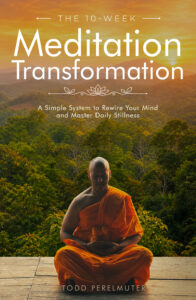
The full 10-week meditation journey, along with expanded teachings and answers to additional reader questions, is now available as
The 10-Week Meditation Challenge: A Simple System to Rewire Your Mind and Master Daily Stillness.
These 5 Minutes Could Shift Your Whole Week
Path to Peace Newsletter
Todd can you please release a paid version of the guidebook to being human on audible where you read the book in your voice? I would love to buy the book to support you. I love when you read your own books.
Also thank you for sharing so much value for free- it shows your intensions are honest. I will share your books with my friends, my barber, etc.