
This article is part of the ongoing Meditation for All challenge. Subscribers to the free newsletter receive weekly guidance and a daily practice.
Meditation vs Mindfulness
What Does It Mean to Be Mindful?
We hear the word, “mindful” a lot. On one hand, it sounds like a full mind, but on the other hand, people talk about it as though it means the mind is empty.
The truth is, mindfulness is the opposite of mindlessness.
When we’re mindless, we’re not aware of our surroundings, we’re not aware of ourselves, and we’re not aware of other people and everything that’s going on around us.
You might be able to relate to this. When you are so absorbed in something, obsessing about the thoughts in your mind, completely lost in the mental story, the thoughts take up your entire field of awareness. You may have had the experience where you look up and you realize you’ve not been aware of anything that’s been going on around you for maybe several seconds or even minutes. This is what it’s like to be mindless, to be completely unaware of our surroundings and ourselves.
The practice of mindfulness is simply becoming alert, aware, and conscious of our body, our surroundings, and even our thoughts without being lost in thought.
Whenever we catch ourselves thinking, especially something negative, that’s a moment of mindfulness.
When we can observe our thoughts without being lost in thoughts, we can even become aware of our own awareness. We can notice that underneath what we see, hear and touch, there is an awareness that is able to perceive all those things.
To understand the difference between mindfulness and mindlessness, think of a video camera recording something. If no consciousness is there to watch the footage, it’s like it didn’t even happen. Our eyeballs are like the camera, but it’s our awareness — our light of consciousness — that enables us to perceive all that we perceive. Mindfulness is being aware of what the robot — our body — is doing and experiencing. That is why we are more than just mindless robots.
At its core, mindfulness is about becoming aware of awareness itself.
When we do this, we identify more with the observer inside us, and we identify less with the thoughts in our head that just come and go and are always changing. Perhaps they’re negative, maybe they’re positive, but they are not who we are. They are what our brain is designed to do, which is think thoughts, and so much suffering arises in this world because we believe that our thoughts are who we are.
Are Meditation & Mindfulness the Same?
Meditation is the practice, mindfulness is the game. We meditate in order to elevate our mindfulness, expand our awareness, and raise our consciousness.
While meditation can be extremely relaxing, it’s not about the minutes that we sit down on a couch and close our eyes. It’s about how those minutes transform the rest of our day and the rest of our lives.
As mindfulness is a state of being that allows us to be fully present and aware of our body, thoughts and environment; meditation is the time we set aside in the day to put away all distractions and develop that deep awareness. When we learn to focus intently and extensively on something as mundane as our breath (or a mantra or our body), the subtleties and minutiae all around us become captivating. The universe comes alive, colors bolder, and sounds more vivid.
By meditating every day, mindfulness naturally arises. Mindfulness is a constant state of relaxed alertness that we can experience throughout our waking life.
When we’re in the shower, we can be fully present with every movement of the body, water, and mind.
When we brush, we can keep our attention on every brush stroke and the sensations of the bubbles and bristles.
When we eat, we can be present with every bite. And when we walk, we can feel the earth beneath every step.
Meditation trains the mind to be present and still. Mindfulness is the result. We may meditate in the morning and/or evening, but every moment is a chance to be mindful. This takes us out of our head, allows us to see beyond chaotic thoughts, and frees us from identification with our mind and its beliefs, ideas, self-image, and conditioned mental reactions.
Every thought we have pops into our head through no choice of our own. Thoughts appear based on our past and what is in our subconscious. We cannot choose our thoughts, but with mindfulness, we can choose which thoughts to listen to and which ones to let float on by.
When we become mindful and present, we no longer respond to life based on our past. A higher wisdom emerges — the wisdom of awareness — which allows us to choose a new course of action that aligns with our highest good.
This is no overstatement. Mindfulness, this developed skill of sustained and intense focus on the present moment, can change our entire life and every aspect of it for the better. Meditation is the tool to help us achieve it.
Meditation vs. Introspection and Contemplation
Meditation is the practice of focus. Through meditation, we train the mind to settle on a single point of awareness and sustain it. The mind learns to take a rest from the constant and draining mental activity it normally engages in.
Through sustained focus, peace emerges. We also develop the ability to direct our mind wherever we see fit, rather than it constantly jumping from thought to thought, or external stimulus to external stimulus, like a wild monkey. It is essentially the opposite of what our minds do when they are on social media, going from post to post without any common thread between them. This is why our minds are so scattered and why meditation is the antidote to ADHD, OCD, and even anxiety and depression, where our mind obsessively ruminates over dark and disturbing fears and worries, getting pulled into dark places against our will.
Introspection and contemplation are completely different, yet each has enormous value in our lives. In this fast-paced attention economy that we live in, we do not spend enough time just staring out the window anymore. We get a steady barrage of information fed into our brain, and almost no time to process all that information. This leads to information overload, where we eventually just collapse from exhaustion.
The human brain needs time to introspect and contemplate our lives — where we’ve been, what we’re doing, and where we’re going. If we don’t, our lives will be unconscious and unintentional. We’ll reach the end and wonder how we didn’t do things that really mattered to us.
Whether staring at a wall, a flower, or out a window, introspection and contemplation are vital to understanding on a deeper level what is happening in our lives.
Like a scientist who studies through observation, we must examine our own lives if we want fulfillment and joy. We must declutter our minds to develop sustained focus, and sustained focus is the act of decluttering.
By reflecting, we can think of a problem or goal, give it the attention it needs, discover a solution or course of action, and then we can set aside that problem and its repetitive thinking for good.
When we are in deep meditation, it can be very beneficial to spend a few minutes while we’re in this relaxed and peaceful mental state to reflect on events, problems, or goals in our lives. In meditation, we are in the middle space between awake and asleep, and so the thinking we do in this state is much more powerful and can transform our subconscious and unconscious minds as well.
We just have to set aside a few minutes in the middle of our meditation to intentionally let the mind wander and see where it naturally gravitates, or we can direct our attention to a specific goal or problem in our lives. We can observe what is weighing on us, what we need to take action on, how we are speaking to ourselves and about ourselves, and use the peaceful inner silence we develop in meditation to help us see our problems with clarity and perspective. Greater wisdom and creativity emerge, the path ahead becomes clear, problems evaporate, and goals are reached with ease.
In the next piece, we’ll explore an important question that often goes unspoken: Is meditation right for everyone, and who isn’t it for?
The Meditation for All Challenge takes place in my newsletter, where I share:
• Weekly practices that accompany the reading
• Common difficulties and how to work with them
• Step-by-step instructions for meditation mastery
If you are reading this on the website, make sure you’re subscribed so you don’t miss the next step.
The Challenge Has Now Become a Book
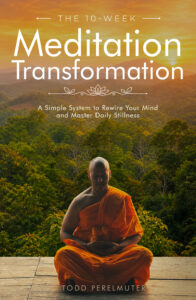
The full 10-week meditation journey, along with expanded teachings and answers to additional reader questions, is now available as
The 10-Week Meditation Challenge: A Simple System to Rewire Your Mind and Master Daily Stillness.
These 5 Minutes Could Shift Your Whole Week
Path to Peace Newsletter