
This article is part of the ongoing Meditation for All challenge. Subscribers to the free newsletter receive weekly guidance and a daily practice.
Meditation is about developing the ability to let go. As we sit in meditation, we watch our thoughts come, and we let them go. Over and over.
We let go of the past and the future and stay rooted in the present. We let go of our ego and the carefully constructed sense of self that we have. We let everything go, and we just sit in deep peace and bliss, the only thing left after letting go of everything else.
Guided meditation is when you close your eyes, and someone else speaks to you. They may guide you to imagine you’re in some relaxing setting, like a beach. They may speak to you about gratitude or healing or love or peace or good habits. Moreover, they may also speak about lowering anxiety, temper, stress, fear, or even procrastination.
The variety is endless, but what they all have in common is that a person speaks for much, if not all of it, while the meditator sits with eyes closed in a relaxed state.
Guided meditation, much like hypnosis, involves positive suggestions or affirmations while in a suggestible state of mind. This type of meditation is very easy to do and is very enjoyable for many people as compared to other meditations they might find more difficult or “boring.”
There is certainly a benefit to relaxing and listening to reaffirming positive messages, whether it’s called hypnosis or guided meditation. It can help with alleviating certain bad habits and create newer and better habits.
What guided meditation does not do is increase our focus, raise our awareness, and make us wiser or more mindful.
Some people feel it really shouldn’t be called meditation at all and that it should really just be called listening to a soothing lecture with your eyes closed. Whatever you call it though, there are undoubtedly benefits to visualizing or listening to positive messages in a relaxed state.
Guided meditation can be a very helpful tool in your spiritual tool belt for getting started, for relaxing, and for making positive changes in your life.
Shall I Start My Meditation Journey With Mantra Meditation?
Mantra meditation, which could also be called object meditation, is the act of focusing intently on one object, word, sound, or sentence in one’s head. Repeating “Om” over and over in your mind for a certain period of time is a very common type of mantra meditation.
Other types of mantra meditation could be visualizing a God, a guru, or the Buddha in your mind. The mantras could be in English or some other language; you may know what they mean or they may be meaningless to you, or they may not even be actual words at all but just sounds.
Mantra meditation is a great starting point for learning meditation. It’s not as easy as guided, but it isn’t as hard as mindfulness meditation. It’s just right for any beginner to start their daily practice of meditation.
For many people, starting straight away with mindfulness meditation is too difficult since most of us live with wild minds jumping from thought to thought, and so before they’re able to clear the mind of all thoughts, just focusing on one thought, such as a mantra, is much easier at first.
Because mantra meditation involves the intent to focus on an artificial sensory perception like a word or object, it does not raise our level of awareness or understanding of reality or the mind. It is great for concentration and focus, patience, and peace, which in itself can decrease stress and increase our joy and contentment in life.
At times, mantra repetition with intense and prolonged focus can even lead to trance-like states, which is why it’s also been called transcendental. Repeating a mantra has been found to reduce stress and depression and improve our mental and physical health.
What’s the Proper Way to Practice Mantra Meditation?
With eyes closed, sit down, and repeat a mantra in your head. It can be Om, Samma Arahang, Buddha, Jesus, peace, let be and let go, or anything else.
You can start with as little as 5 minutes a day. Truly commit to doing this everyday for one year. After one year, maybe try 10 minutes. There is no rush. Sustainability is the name of the game. The effects are accumulative and this will give your mind a chance to settle and relax in a way that it has never experienced before.
Focusing on a mantra is a great way to begin meditation. Clearing your mind and focusing on your breath is very difficult when you’re first starting out. Your mind may be racing, and you might be thinking about a million things. So, with a mantra, you think about one thing before you try to think about nothing.
It’s easy to think about one thing. Thinking about no thing, as in breath meditation, can be very difficult. But a mantra is a very powerful way to focus your mind when it’s got a million things going on.
So, whenever you’re meditating for the first time, I highly recommend a mantra. Try “Om.” It works wonders. Just repeat it over and over in your mind, just like this: “om, om.” Don’t worry about the speed; just let it flow naturally, not rushed, very effortlessly and naturally, like you turn on a faucet, and the mantra comes out, and you just let it keep coming.
You will probably get distracted while repeating the mantra in your head. You’ll start thinking about other things, you’ll lose the mantra. That’s okay; just bring it back. Gently bring it back over and over as you develop the skills of focus and concentration. This will increase your attention span and your ability to enjoy the simple pleasures and sometimes slow pace of life.
When you can focus on something besides the constant stream of thoughts in your brain, a deep peace comes over you. It’s very powerful, profound, and relaxing. You’re giving your mind inner stillness as the mind remains fixed in one place, allowing for deep rest, rejuvenation, and more energy.
I know some longtime monks who have been doing mantra meditation for years and will probably continue to do so for life. We don’t have to progress to harder meditations. Every person is different. Play around. Explore. Try different things, See what works for you.
Don’t worry so much about the technique, if you’re doing it wrong, or how long you’re doing it for. Meditation works. There are thousands of different techniques. The key is to practice keeping your focus on one thing. You could be watching the ocean waves, a candle, your breath, a mantra, the back of your eyelids, visualizing a light or a crystal, or anything else. It’s even okay if you’re thinking all the time. Old habits don’t change easily. Just keep it up, do what you find most relaxing and easy, let go of hopes for instant results, and enjoy the journey.
In the next article, we’ll talk about how to meditate if you can’t sit still.
The Meditation for All Challenge takes place in my newsletter, where I share:
• Weekly practices that accompany the reading
• Common difficulties and how to work with them
• Step-by-step instructions for meditation mastery
If you are reading this on the website, make sure you’re subscribed so you don’t miss the next step.
The Challenge Has Now Become a Book
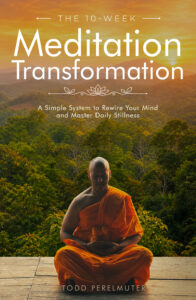
The full 10-week meditation journey, along with expanded teachings and answers to additional reader questions, is now available as
The 10-Week Meditation Challenge: A Simple System to Rewire Your Mind and Master Daily Stillness.
These 5 Minutes Could Shift Your Whole Week
Path to Peace Newsletter