
This article is part of the ongoing Meditation for All challenge. Subscribers to the free newsletter receive weekly guidance and a daily practice.
Mindfulness meditation or awareness meditation refer to the act of observing some phenomena in the present moment with great concentration.
To observe the present moment, the mindfulness meditator’s main aim is to focus. They may focus on their breath, their body, their surroundings, or a task, such as eating or walking, with great focus and concentration.
This heightened, extended focus on the minutiae of one’s senses leads to an ever-deepening awareness of subtlety and detail, reflecting back to the meditator an understanding and wisdom into the nature of perception and the nature of reality.
The more we look at anything, the more we notice. The more we notice, the more we understand.
For this reason, mindfulness meditation not only increases our concentration, awareness, and wisdom; but also the knowledge and insight into who we truly are as this pure awareness. We begin to see things more clearly by seeing through the fog of thoughts and judgments.
As we train our mind to observe the present moment without judgment, we stop our near-constant living in the past or the future. We experience life more fully and vividly.
Moreover, we stop living in the dream of thought and start living in the here and now. We see reality for what it really is, not as our opinions or preconceived misconceptions put on top of it. This is why “Buddha” simply means the awakened one — awakened to life, awakened from the dream of thought.
Many scientific studies have been done on the brains of long-time meditators and the findings have been remarkable. When Buddhist monks had their brains hooked up to electrodes, we found that their brains are visibly different from people who do not meditate.
The fear centers of the brains are smaller, their empathy regions are larger, the part of their brains responsible for regulating their mood are substantially bigger, and they have more gray matter in general. In a large study of monks, mental illness was almost non-existent, much greater happiness and peace was reported, and even physical ailments were much rarer than the general population.
Vipassana Meditation
Vipassana meditation is a type of mindfulness meditation. Also called insight meditation, Vipassana is typically practiced using breath awareness or body scanning. Vipassana recommends starting with breath awareness meditation for a few days or weeks. Then, practitioners may move on to body scanning. The breath helps refine our focus and attention before moving on to the subtler sensations in the body.
Here’s how to get started:
Type 1) Breath Awareness Meditation
Sit on the floor with your legs crossed if that is available to you.
Close your eyes, breathe naturally, and put your entire focus on your breath.
Begin by either focusing on your expanding and contracting belly, or by focusing on your nose and mustache area. Feel every little, subtle sensation of your breath there.
When your mind wanders off, gently bring your attention back to your breath. Just feel the air coming in and going out.
After a couple of days, your senses will heighten. Then, narrow your focus to just a small point above your upper lip (think Charlie Chaplin mustache).
Tune into the very subtle feeling of cool air brushing by as you inhale, and warmer air coming out on the exhale.
Do this for 5 minutes to start out and slowly work your way up to 20 minutes or longer. After a few weeks, if you can sustain your attention for a few minutes, and feel the air brushing by your upper lip, you can move on to body scanning. Some people like to do 5 minutes for a whole year, establishing a solid practice, before increasing their time. There is no rush. Consistency matters most.
If you want to just do breath meditation for the rest of your life, that is absolutely amazing. Meditation is meditation. The different styles are just different vehicles, the destination is the same.
Type 2) Body Scanning Meditation
Now that you have laser-like focus, start this meditation the same as breath meditation. Sit on the ground (or a chair if you need to) and close your eyes.
Then, put all of your focus at the tippy top of your head. Feel the feelings of that area. Then you will slowly move your attention down to your toes.
Imagine a grid of vertical lines covering your body from the top of your head to your toes. Imagine each vertical line spaced an inch or two apart. In whatever order you prefer (but make sure you do it in the same order every time), move your focus slowly down each line, sensing every spot of your body.
Feel your body from the inside and on the surface. Make sure you are really sensing each spot, whether it’s clothes on your skin, heat or cold, tingling or pulsing. Whatever sensation is there, just feel it.
If you can’t feel anything in a particular spot, just stay with that spot until you feel some sensation. Our nerve endings are always picking up signals and sending them to our brains. The more you practice, the more connected you will be with your body.
Continue moving your attention down each line from the head to the toes until you’ve scanned your whole body. This will take roughly 10 to 15 minutes.
Once you’ve scanned your whole body, move your focus from your toes to your head in reverse order. This is one complete cycle. Do this as many or as few as you like.
Now you are also learning two new powerful skills. 1) How to direct and guide your mind at will. 2) How to move your awareness out of your head and into your body. Most of the time, we don’t move our center of focus away from our head. Our thinking, seeing, hearing, smelling, and tasting keep our center of consciousness rooted in our head. This practice helps us expand beyond this sense of an illusory source of ourself existing within our head.
A Word on Dynamic Meditation? What Is It and How Is It Different From Others?
Without getting too much into it because it’s something quite different altogether, there is one more type of meditation that causes some confusion for people. That is dynamic meditation and it involves movement of some kind. This is most commonly done through singing or dancing.
Both of these activities have wonderful benefits, like boosting certain happiness chemicals in the brain, releasing trauma, and activating the vagus nerve. They also get the body moving which is very healthy.
However, while singing and dancing are very meditative practices, I put them in a separate category from everything else we’ve talked about so far. This is because they do not fundamentally transform how we experience and perceive the world after the meditation is over.
Meditation is about training the mind. Once it’s over, we see things more clearly. We are able to focus better. We’re more aware and wiser about the world around us. Singing and dancing are excellent stress relief valves. But meditation turns off the stress pump altogether so we no longer need to relieve the pressure.
There are many activities that can be called meditative. The list includes swimming, cycling, performing, making art, yoga, and so on. They are meditative because they force us to be present and can help clear our heads. But do they increase our present moment awareness afterwards? Unfortunately, no.
While dynamic meditation is very fun, and having fun in life is important, it does not fundamentally change how we see and take part in this world. It does not train our minds to focus better, to increase our awareness, or to deepen our understanding.
Still do them. Meditative activities make life worth living and are the key to a happy and healthy life. But be sure to set aside some time for sitting meditation, free from all distractions, so the mind can reach a deeper level of stillness and clarity.
In the next blog, we will talk about which meditation is best out of all the ones we discussed so far.
The Meditation for All Challenge takes place in my newsletter, where I share:
• Weekly practices that accompany the reading
• Common difficulties and how to work with them
• Step-by-step instructions for meditation mastery
If you are reading this on the website, make sure you’re subscribed so you don’t miss the next step.
The Challenge Has Now Become a Book
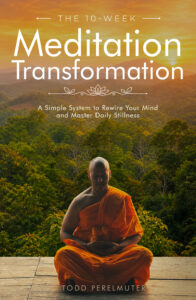
The full 10-week meditation journey, along with expanded teachings and answers to additional reader questions, is now available as
The 10-Week Meditation Challenge: A Simple System to Rewire Your Mind and Master Daily Stillness.
These 5 Minutes Could Shift Your Whole Week
Path to Peace Newsletter