
This article is part of the ongoing Meditation for All challenge. Subscribers to the free newsletter receive weekly guidance and a daily practice.
For some people when starting out, they need a guided meditation or music in order to relax at all. But the most beneficial types of meditation make you the guru of your own mind. They let you do all the work so you get all the benefits. This journey is all about you and only you can take yourself where you need to go.
You are your own guide. You don’t need to give your power over to anyone else. Not only that, but you are already whole and complete. Your time for meditation is merely about connecting with, and rediscovering, your true self.
It may be a little less entertaining than a guided meditation, but that is the point. In meditation, we want to remove all distractions and get rid of all material necessities so that you can do it anytime, anywhere.
For many beginners, and even experts occasionally, using sounds and objects can be very beneficial. But to get the most benefits, simply sitting with your eyes closed in silence is the best way to raise your level of consciousness, concentration, and contentment.
If we rely on music or guides, we become dependent on music and guides. If we focus on someone else’s voice, we train our mind to only be able to focus on someone else’s voice. When we just observe our mantra or breath, we train our mind to be able to focus on anything we wish. It’s like how if we spend all our time watching shows or playing video games, real life becomes boring and our mind will become too dull to appreciate the simple and slower things in life. That’s why we choose focusing on a mantra or our very subtle breath — this is how life becomes more vibrant and beautiful.
As we spend more and more time observing our thoughts and emotions, the more we understand the nature of our mind. The more we understand, the wiser we become, the more blissful we become, and the less we unconsciously create needless stress and suffering.
Just remember these 5 tips and your meditation experience will always be amazing:
- Let go of expectations
- Be kind to yourself
- Become accepting of your feelings
- Don’t worry about if you’re doing it wrong, just keep doing your best
- Stick to it every day
Other Things to Remember Are:
Don’t Let Meditation Take Over Your Life
Many in the West are choosing to learn meditation as a technique to achieve more success and material possessions. They are skipping the spiritual teachings that accompany this ancient technique. While this is fine and still beneficial, they are only getting half the benefits.
Meditation is about gaining wisdom and insight, learning moderation, becoming a more conscious and compassionate person, seeing reality as it is, and learning to take the middle path — not too rigid, not too lazy. Without practicing good virtue, meditation can become a selfish and isolating pursuit.
Anything in life can be done to an extreme. So, if meditation takes over your entire life, if you withdraw from your family and you begin to shirk your responsibilities, this is not wisdom.
However, with proper meditation and intention, you will be sure to maintain balance in your life.
It is possible that after doing meditation for some time, you will realize that certain relationships are not healthy and you may wish to remove yourself from a them. Not only this, but you may discover that a job is not right for you any longer and you may wish to do something different.
Moreover, you may find that certain activities you were doing weren’t serving your highest good and you may make a change. These are all some of the beautiful benefits that come from meditation as we become wiser, happier, and healthier. However, if you withdraw from all people and all labor, this is not an example of wisdom and presence, but rather ignorance and avoidance.
Don’t Rush Through Meditation
Your daily practice of meditation is a marathon, not a sprint. You want sustainable, slow progress. If that sounds too slow for you, don’t worry, meditation is about learning patience. Forcing too much too soon is one of the most common meditation mistakes that can cause anxiety.
By making 1% progress everyday, according to compounded interest, you’ll see 100% improvement 70 days. You’ll be 100% more peaceful, calm and joyful. All the benefits grow exponentially.
But if you try to do too much too fast, you are more likely to quit or cause yourself needless anxiety. Meditation is a time to be gentle with yourself. To express self-love. To nurture and heal yourself. And most importantly, to listen to your body’s intelligence.
Start with just 5 minutes if meditation is causing a lot of anxiety. If you can, do it twice a day. But start small with something you can stick to and then make the commitment. Set a fixed time and do your best to never miss a day. However, if you do miss a day, don’t be hard on yourself either. Meditation is a beautiful, simple, and powerful process of love and healing.
Don’t Meditate in a Way That Feels Forced
Don’t meditate in a way that feels like such an enormous challenge that you give up on it after 2 minutes. Try a few different types and do the one that feels the best for you. There’s no need to torture yourself or make it harder than it needs to be.
Some people love to listen to music or use meditation apps. Others like to be guided. Some people like to stare at the beach, a candle, or a crystal. Some folks like to use a blindfold. No type is bad. At your own, unique pace, you can slowly increase your time or move on to mantra or breath techniques if that feels right for you.
Don’t Put Too Much Pressure on Yourself
Meditation is about relieving stress, not adding to it. We’re so used to being perfectionists in our daily life that we put pressure on ourselves in meditation. It’s exactly that kind of habitual thinking that meditation can help us break free from. Always remember to relax and go easy on yourself.
Furthermore, meditation isn’t about any desired outcome. It’s about the here and now. If you are sitting in meditation, you are doing it perfectly. Know that there is no “doing it wrong” when it comes to meditation.
Effort is all that matters. What you put in, you get out. Being too hard on ourselves is another big meditation mistake that causes anxiety, pressure, and stress.
Don’t Fall for Fake Meditation
Do not join a cult! Do talk to an experienced meditation instructor if you have tried to meditate on your own for a long time and are still facing problems. They can answer all of your questions and guide you in the right direction.
There are a lot of huge corporations out there right now that want to sell you a meditation experience, but their technique might have nothing to do with actual meditation. Many companies have co-opted the word meditation and instead of giving people what they need, they sell people what they want — a very pleasant experience but not a very useful one.
There’s no quick fix or easy pill to take to get the benefits of meditation. You get out what you put in just like everything else. There are many paths to the top of the mountain. Find the one that’s best for you. It’s not a race. Go at your own pace and you’ll be sure to reach the top.
With that, we conclude our meditation challenge. Thanks for joining. Be proud of yourself. It’s not easy to do this work on ourselves. It takes courage to look within at the dark corners of our psyche. You are now a black belt spiritual warrior. Congrats.
The Meditation for All Challenge takes place in my newsletter, where I share:
• Weekly practices that accompany the reading
• Common difficulties and how to work with them
• Step-by-step instructions for meditation mastery
If you are reading this on the website, make sure you’re subscribed so you don’t miss the next step.
The Challenge Has Now Become a Book
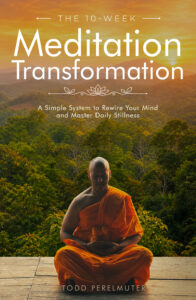
The full 10-week meditation journey, along with expanded teachings and answers to additional reader questions, is now available as
The 10-Week Meditation Challenge: A Simple System to Rewire Your Mind and Master Daily Stillness.
These 5 Minutes Could Shift Your Whole Week
Path to Peace Newsletter