
This article is part of the ongoing Meditation for All challenge. Subscribers to the free newsletter receive weekly guidance and a daily practice.
Do these thoughts sound familiar when you’ve begun to try meditation: This is taking forever! How long until I feel something? Am I even doing anything?!?!
Our normal thinking mind will grasp at anything to latch onto, and many of us have had thoughts like these. However, even though our awareness may not be heightened enough to notice such subtle daily changes, benefits can be gained right away.
Whenever we start anything, we naturally want to know if it’s worth our time, what the benefits are, how long it takes, and so forth. In everything we do, we think about those aspects. Regardless of the activity — whether it’s learning a new sport, mastering an instrument, or learning a new language — everyone will advance at their own speed.
Some people will have a natural talent and ability, others will need to work a little harder. But what we do know with 100% certainty is that everybody can improve with practice.
Whether it’s basketball or meditation, we must start with building a strong foundation. In basketball, we might start with dribbling and bouncing the ball. You can get decent at bouncing the ball on the first day. However, maneuvers like shooting and layups may be a bit more challenging.
But that doesn’t mean you can’t get some benefits right away. Meditation works in a similar way. You may not reach a super heightened state of awareness after your first session, but you may notice you’re a little more relaxed, a little more easygoing, with less tension, and possibly even reduced back or shoulder pain. If you practice properly, you will start getting benefits right away.
It’s also similar to learning a language — a long process. We don’t need to rush ourselves in meditation. It’s truly about developing patience, not placing tight deadlines and big demands on ourselves. It’s about accepting where we are.
Being fully in the moment, we’re not attached to any future outcome whatsoever. Meditation is about being here, now—there is no goal we hope for while we’re meditating. Although we may have goals we wish to achieve, meditation must simply be about sitting down, closing your eyes, and giving yourself the time and space to be. As far as the thinking mind goes, there is absolutely nothing to worry about. The rest will fall naturally and effortlessly into place.
If you go play basketball and, on your first day, you want to be Michael Jordan, you’re going to be really disappointed. You might quit because you aren’t living up to your expectations. Therefore, we must set reasonable and realistic expectations and goals.
When starting meditation, I often like to tell people that the full results, the total benefits, and the feeling of deep peace and ease may take time to develop. Reaching a place where we can meditate without letting it generate negative emotions requires patience. Initially, our minds might wander to thoughts of things we’d rather be doing or what we’re going to eat next.
Over time, our mental state evolves into a peaceful joy. That’s when the real magic happens, when a peaceful mind nourishes us and feeds our soul more than entertainment or sensual excitement ever could.
On average, it can take between one and six months to see noticeable changes. It’s very common for people to eventually say, “Wow, how did I ever live without it?”
Starting out at just five minutes is a great start. Slowly and patiently, you can gradually increase your time, working up to 20 minutes is a great goal. If you can manage 20 minutes twice a day, you’ll double your benefits and enhance the speed of progress.
While starting and ending the day with meditation is best, everyone is different and people are at different levels, so it’s essential to listen to your heart and do what feels right for you.
When I first started meditating, I was the worst meditator. I was so fidgety, couldn’t sit still for two seconds, constantly scratching my head and chin, and squirming as if I wanted to be anywhere else. I thought, “This is not for me.” But I stuck with it.
Within about two months, I could sit still for an hour. Now I can’t live without it. The difference is noticeable when I miss a day, which almost never happens because I can always squeeze in a few minutes somewhere. Because I strive to be the best person I can be for my loved ones, I make an effort to do it every single day, and I rarely fail.
Occasionally, life gets in the way, but we do our best. Instead of regretting or feeling bad and attacking ourselves, we can choose to love ourselves even more. We just resume right away. We make it a point never to miss a day unless it’s an extreme, unforeseen emergency that makes it impossible. Because we practice every day, we can better survive those challenging days because we’ve sharpened those tools in our spiritual tool belt — mindfulness and presence.
The ultimate goal is to make our daily life a meditation practice, living in that meditative state at all times — fully present, using our mind concsiously, and not letting it use us 24/7 with its incessant, constant, repetitive, negative, unconscious thoughts. Achieving this is possible, but it takes time.
They say the Buddha trained for seven years in meditation and spirituality. Finally, he sat under a tree for 49 days, and on that last day he attained supreme enlightenment. So, be patient. While it does take time, you can experience benefits right away. Even if you may not notice them, others might see the positive changes.
The more aware you become of subtlety and nuance, the more you will realize the significant impact it’s having on you, and you’ll wonder how you ever lived so long without it.
Meditation Hasn’t Been Benefitting Me. When Can I Give Up?
Most people can’t sit down and instantly clear their minds. They think they must be doing it wrong. Or worse, they think they just can’t meditate and that meditation is not for them. But if I were doing something my entire life – thinking – and suddenly tried to stop, it’s not going to happen as fast as I’d like it to.
Luckily, meditation is not about clearing your mind of all thoughts. It’s about becoming conscious – or mindful – of your thoughts. The more aware we become of our thoughts and the more we sit still without distraction to simply observe our mind, the more our mind stops mindlessly creating suffering and the more we can consciously choose to create joy and peace in our lives instead.
Sometimes people have certain expectations about their meditation practice. They expect perfection right away or else they think it’s not for them. If suppressed emotions bubble to the surface, they think meditation caused the painful emotions. In reality, that is a wonderful thing. It means emotions that have been pushed down for far too long can finally be processed and released.
Suppressed emotions are what cause problems like illness, stress, pain, anger, addiction, and losing our temper. Whatever comes up in meditation is good and healing. It’s like having a good cry at the therapist’s office. Don’t rush your feelings or expect change overnight. Stick with it. If you’ve been suppressing emotions for decades, allow time for yourself to heal through meditation.
Experiencing anxiety while meditating is also a sign that underneath your conscious mind, there is anxiety you have yet to deal with. Not letting go of expectations is one of the biggest meditation mistakes that can cause anxiety. The more unpleasant meditation is at the start, the more necessary meditation is.
Are Lacking Results Indicative of Doing Meditation Wrong?
Yes, no, sorta. Oftentimes, we are not aware of a 5 or 10 percent change in our mood, thinking, and behavior. But that doesn’t mean there’s no change. Sometimes, only when we look back over a long period can we see the change in our life.
Remember, the more meditation can be just for the sake of the meditation itself, the more effective our meditation can become. In Zen they say, you are a master the moment you sit down onto the meditation pillow. Just sitting is the purpose.
There is also no wrong way to meditate. Zero. Sitting as still as possible for 10 minutes with eyes closed is hugely beneficial in regulating our nervous system, relaxing, processing our thoughts, making some space in our day to decompress, and give the day some breathing room.
Some meditations can produce different effects. If your mind is very active, a mantra tends to be helpful. If your mind is not restless and more focused, mindfully focusing on your breath can help raise your consciousness and expand your awareness by observing the subtle nuances of each breath.
If you can’t focus on your breath, try a mantra. If a mantra is too hard and life is too chaotic, try a guided meditation. You are your guru. You know what you need in each moment. Simply adding some peace and quiet to your day is hugely beneficial.
For How Long Should I Meditate to See Results?
For some people, meditating for 5 minutes might be all they can do when first starting out. Luckily, there is science to back up that just a few minutes can provide numerous benefits to the mind and body.
Over time, try working your way up to 20 or 30 minutes, once or twice a day. This will be enough to give you all of the extraordinary benefits meditation can provide. Numerous scientific studies show that just 20 minutes a day leads to significantly greater joy, patience, focus, and quality of life.
No matter what we put our effort into, we naturally want to see some results. So, the question really is, “How long do I have to meditate to see results?” The more effort you put in, the more results you will see. But if you try to do too much and quit, you lose the benefits. So don’t try to be Superbuddha on day 1.
Just one moment of bringing your attention to the present moment and setting down the weight and baggage of the past and the future can change your whole day. Feeling that weight off your shoulders because you’re fully present, and there’s nothing else but this moment, can inspire and motivate you to keep going. That can lead to more and more moments throughout your day where you can remember that feeling, repeat the process, and become present. 1 moment can become 10, 10 can become 100. One second can become five, five can become 10.
Anytime is the best time. However long you can is the right amount. Five to 10 minutes is more than enough time to activate the parasympathetic nervous system — the rest and recovery state of the body.
Our bodies don’t know understand modern-day stress. They don’t know that we’re not in physical danger during a high stakes business meeting. If we don’t practice peace, long-term stress can transform into depression and a myriad of chronic conditions.
When our sympathetic nervous system remains activates — the chronic fight or flight stress response — we become exhausted. The body expects exertion, like running away or fighting, but instead those stress chemicals build up, literally zapping us of energy.
Just five minutes allows our body to de-stress, heal, and process whatever it’s going through. It doesn’t have to be a significant stressor; it could be traffic, work, or anything you were worried about, such as a loved one.
Anything that generates stress has to be processed or else it accumulates. Meditation is the time to reflect, work with, and release. Usually, by the end of five minutes, you’re not thinking about the same thing or feeling the same way as when you started. There’s no better way to communicate to your subconscious that you are safe, that life is peaceful, and that you are there for yourself.
In the next article, I will share advice for new meditators.
The Meditation for All Challenge takes place in my newsletter, where I share:
• Weekly practices that accompany the reading
• Common difficulties and how to work with them
• Step-by-step instructions for meditation mastery
If you are reading this on the website, make sure you’re subscribed so you don’t miss the next step.
The Challenge Has Now Become a Book
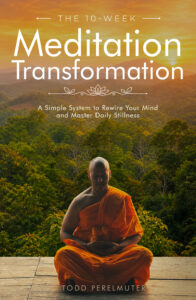
The full 10-week meditation journey, along with expanded teachings and answers to additional reader questions, is now available as
The 10-Week Meditation Challenge: A Simple System to Rewire Your Mind and Master Daily Stillness.
These 5 Minutes Could Shift Your Whole Week
Path to Peace Newsletter