
If we were to see reality as it really is, all of our expectations would be met. But because we have limited perspectives with limited information, we expect things to happen that end up not panning out. When we expect things, we place our opinion of how things should be above everyone else’s and above what the universe had set in motion long before we were even born.
But what if we could look at life another way? Could we put aside expectations entirely? Could we open ourselves to the wants and needs of others, as well as our own? And what would happen if we traded in our expectations for hope?
Why Unfulfilled Expectations From Life Cause Internal Resistance
When we expect life to be a certain way and it doesn’t end up happening, we begin to resist reality and we create an inner war between us and the universe. Whether we expect a great career, a big house, a fast car, awards and recognition, a big social circle or lavish vacations (usually because we see all of these things in the movies and media), by expecting them to come by a certain date almost guarantees pain and suffering when the universe has a different plan or a different schedule in mind. But if we hope for them instead, we stay open to new opportunities, we stay energized and optimistic during minor setbacks, and we are more likely to achieve all that the universe has in store for us.
Hope is trusting that the universe has your back. Expectations are you saying you know better than the infinite magical wonder of the universe. How we choose to view the world not only changes our perception, it literally changes how the world responds to us.
How Expectations Hurt Our Relationships with Others
When we expect people to be a certain way, we are also telling them that we know better than they do. No matter how well-intentioned, placing expectations on others negates their own sovereignty to determine the course of their own lives, to make their own mistakes, and to learn from them. Furthermore, expectations imply disappointment if the other person doesn’t comply with your wishes, and so expectations are inherently wrapped up in emotional blackmail and manipulation.
Conversely, we can hope people change, we can hope people be kind and honest, and we can hope people do the things we wish. If they do change, great. If they don’t, we’re still hopeful. But to expect others to not live out their own karma (the cards they were dealt in life), to not play their role in this universe, would be to live in delusion.
People can only meet us where they are. We are all at a different place on the same journey. Some people will go far, while others may falter and stumble. That is OK. All we can do is be there to help the people who are willing to be helped so they can get back up and on the right track. While we can’t force others to change, we can change ourselves, and that can inspire others.
With expectation comes disappointment. With hope comes love, optimism, and courage.
Releasing Attachment to Achieve Your True Goals
Always Remember:
Not wanting is not the same as not working towards something or not achieving something. Quite the opposite. Not wanting means that you will work towards your goals without attachment to the results and without fear of failure, thus more of your goals will be achieved and more effortlessly than ever.
Not wanting is also not the same thing as not doing or just accepting whatever is in your life. Without desire or attachment, we can work even harder to overcome adversity because we won’t be creating mental resistance and draining our own energy. Good and bad things will still come and go, but without being clouded by desire, our happiness will no longer be dependent on those temporary circumstances, and our contentment and satisfaction can begin to grow exponentially.
Finding Equanimity in Uncertainty
Let’s take a moment to remember that no one knows what will happen. Sometimes, what we hope will happen turns out to not be the best thing for us. Other times, when things go “wrong,” we later discover how much of a blessing it turned out to be. By reflecting on this deep truth, we can remain equanimous no matter what is happening around us.
The Root of Unfulfilled Expectations: How Compulsive Thinking Creates Inner Drama
The Art of Gratitude
No matter how dark a situation is, there is always something to find gratitude in. Discover how shifting your perspective transforms every challenge into growth and unlocks lasting inner peace.
Most of the problems in our lives are generated by our thinking mind.
When we’re depressed, we are constantly thinking dark, negative thoughts.
When we’re anxious, we’re constantly thinking insecure, anxious thoughts.
When we’re caught in the drama of life, we are usually retelling that story of drama in our minds, again and again.
To be free from this compulsive thinking is to be free from much of the suffering we create for ourselves.
Usually, the narrative we repeat in our minds — the one about the most negative thing that happened to us, is running unconsciously. The mind is always scanning for something negative to blame everything on. But even a single moment of clarity and peace can interrupt that train of thought. And when we do that, we create a new track. The more we do this, the more we break out of these habitual patterns of thinking, these downward spirals we so often fall into, where one little thing going wrong ruins our entire day.
When we create moments of quiet in the mind, we stop fixating on what we don’t have, what we want, or what we feel we need. We come into the here and now. And when we give our full attention to this moment, all possibilities for how best to respond to the situation can emerge, free of fear or desire. In that clarity, we can see the full picture. We’re able to recognize the good and bad in each choice, and lean toward the path with the most good and the least harm.
But when we’re stuck in fear-based thinking, constantly bouncing between imagined futures and painful memories, we can’t truly respond to life, because we’re not fully in life. We’re not grounded in the present. For guidance when old regret resurfaces, read about what to do when the present keeps reminding you of your past mistake.
Finding Wisdom Beyond Expectations in the Space Between Thoughts
There’s been a great deal of research into the creative process, and one consistent insight is that true creativity comes in the gaps between thoughts. Those quiet spaces, those moments of no-thinking, are where breakthroughs and clarity arise. Einstein didn’t develop the theory of relativity while buried in books. He came up with it while playing the violin or going for a bike ride. Newton didn’t discover gravity while doing math, it came to him while sitting under an apple tree, simply being. We don’t access our deepest wisdom through constant thinking. We access it by creating room for new possibilities to come in.
When we identify with that which constantly changes — our roles, our careers, our achievements, our image — we live with the fear of change. Every identity built on something temporary will inevitably cause suffering as those things shift, evolve, or disappear.
Many people tie their identity completely to their job. So when they lose it, or even retire, they suffer immensely. Even the fear of losing our lives becomes a heavy burden when our identity is built on this impermanent self. That subtle, constant pressure can manifest as anger, addiction, chronic pain, or burnout.
Connecting to Eternal Consciousness to Overcome Life’s Disappointments
But when we identify with that which is eternal and formless, with the one life that animates every being on this planet, with the consciousness that underlies all existence, then fear disappears. We no longer feel like victims of our circumstances. Instead, we feel a creative, courageous spirit flowing through us. We no longer believe the universe makes mistakes. We no longer feel like slaves to some unforgiving fate.
When we identify with the source of life that created everything and lives within everything, we begin to recognize the perfection of our own design. We realize there is nothing to fear, nothing that can be taken from us, because we are one with everything.
But when we identify only with our physical body, our name, our labels, that’s when we start to feel like we’re never good enough. That’s when we constantly compare ourselves to others.
Living in Sacred Wonder
When we recognize the miracle of life inside ourselves, our oneness with the universe, we begin to live in a state of awe and wonder. And from that place, every ordinary act becomes sacred. Every moment becomes enough.
Free Book Download
Are You Happy?
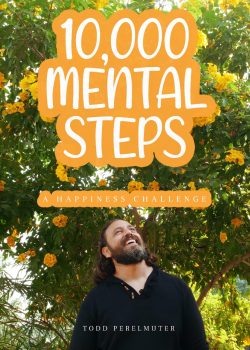
Be a part of the 10,000 Mental Steps challenge